

Your Brand Is a Challenger. Stop Treating It Like a Defender.
Every Swiss market worth attacking already has a Defender protecting it. Most new brands respond by copying that Defender’s codes: same blue, same reassuring tone, same urge to speak to everyone. That isn’t strategy. It’s surrender dressed up as a brand book.
Only one customer in ten believes the brand they buy is genuinely unique, according to Lippincott’s 2023 study of more than 250 US brands. The market has already ruled: 90% of brands look alike. Looking like the leader on top of that means disappearing twice.
Please everyone, or speak to one precise sector
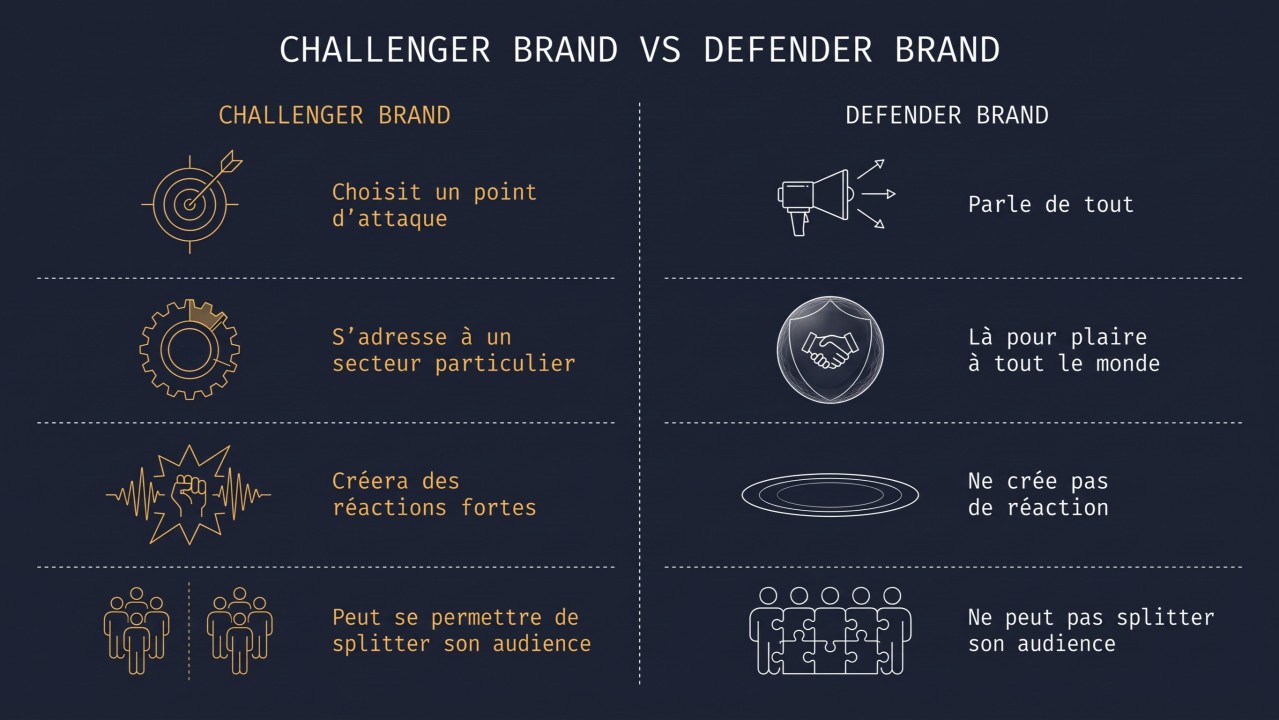
The same logic repeats on audience. A Defender tries to please everyone, because its business model rests on broad volume and a consensus reputation. A Challenger speaks to one particular sector, because that is the only audience where it can afford a real advantage. Against a giant with the means to be a generalist, specialisation is the only weapon left.
A founder who tries to please everyone from launch has no audience strategy at all. What they have is an absence of choice, disguised as ambition.
Provoke no reaction, or go after a strong one
A Defender Brand provokes no reaction, and that is deliberate: communication that disturbs nobody is communication that protects a base already won. Silence is not a failure for a Defender. It is often the objective.
A Challenger Brand that provokes no reaction, on the other hand, has failed. With no reaction, positive or negative, there is no recall, no word of mouth, no reason for a market already held by a leader to even notice a new entrant exists. Going after a strong reaction is not an aesthetic choice. It is a condition of survival.
Unable to split the audience, or free to do it
A Defender Brand cannot afford to split its audience, because dividing means risking part of what it already owns. Any decision that might alienate a segment of its current base is, by default, a bad decision for it.
A Challenger Brand can afford to split its audience, because it owns nothing it stands to lose, and has everything to gain in the segments where it chooses to fight. A position that drives part of the market away while winning strong commitment from another part is not a risk for a Challenger. It is often the best proof that it has finally picked a side.
Copying the leader is an admission of weakness
A Challenger Brand studies a market’s established codes for one reason: to break them. If the whole market communicates in blue, it goes red. If the whole market uses sans-serif type to look modern, it goes serif to look different. A Defender Brand does the opposite and imitates the codes, its own and those of its peers, because familiarity reassures a customer base that doesn’t need convincing, only confirming in its choice.
Copying the leader’s codes while you are a Challenger amounts to dressing up as a Defender without the budget, the customer base or the legitimacy. The market doesn’t see a brand that has proved itself. It sees an underfunded copy of the brand that already did.
That imitation reflex usually starts from a good intention: reassure a first client, look “serious” to buyers used to the incumbent. Over the medium term it is a losing calculation. A buyer hesitating between a brand that looks like the leader and the leader itself almost always picks the leader, because at equal appearance, age and size settle the debate. The only way to make that buyer even consider an alternative is to give them a visible, immediate reason to know they are not dealing with the same thing.
Message Map: choosing the one strength you repeat everywhere
Breaking visual codes isn’t enough if there is nothing specific to say behind it. A Challenger Brand has to identify the one strength where it can legitimately claim to be better than the leader, and make that its single message, repeated across every touchpoint. That is exactly what a Message Map is for at Enigma: one page that forces you to pick a single claim and discard all the others, so the brand says the same thing everywhere instead of something different in every channel.
A Defender doesn’t need that choice. It can afford a more diffuse message, because its size and its age do the work that message clarity should be doing for a Challenger.
“But I’ll lose customers by segmenting.” That’s exactly the point, and you’ll win twice as many.
The objection comes up at every launch: segmenting, aiming at a precise point of attack, accepting a divided audience, isn’t that giving up customers you could have kept by staying broader? The answer is yes, and that is exactly why it works.
A Challenger Brand that refuses to lose anyone attracts no one strongly. It produces a message diluted enough to disturb none of the segments it could reach, and therefore bland enough to convince none of them either. The market share you think you are protecting by staying broad doesn’t exist yet: there is nothing to lose, only an audience you will never truly have won. A Defender protects a real base by avoiding division. A Challenger protects an illusion by avoiding the choice.
So what is your brand’s mission?
The day you dominate your market, you can settle down. Speak to everyone. Avoid making waves. Imitate the reassuring codes of a mature sector, because by then you will be part of it.
But not now. Not at the start. A brand that settles down before it has won has nothing to defend and still behaves as though it already had everything to lose.
It may be the most common trap I see with Swiss founders: they borrow the caution of a hundred-year-old company at a stage where the only thing excessive caution guarantees is staying invisible long enough that the question of one day dominating the market never comes up at all.
Start by deciding: is your brand going after market share, or trying to hold on to share it doesn’t have yet?
Then build accordingly: a chosen point of attack, a Message Map that settles the claim once and for all, and the acceptance that a splitting audience is not a failure while you are still conquering.
A Defender protects what it already has. A Challenger goes after what it doesn’t have yet.
And your last few brand decisions: which of the two boxes would they really put you in?